
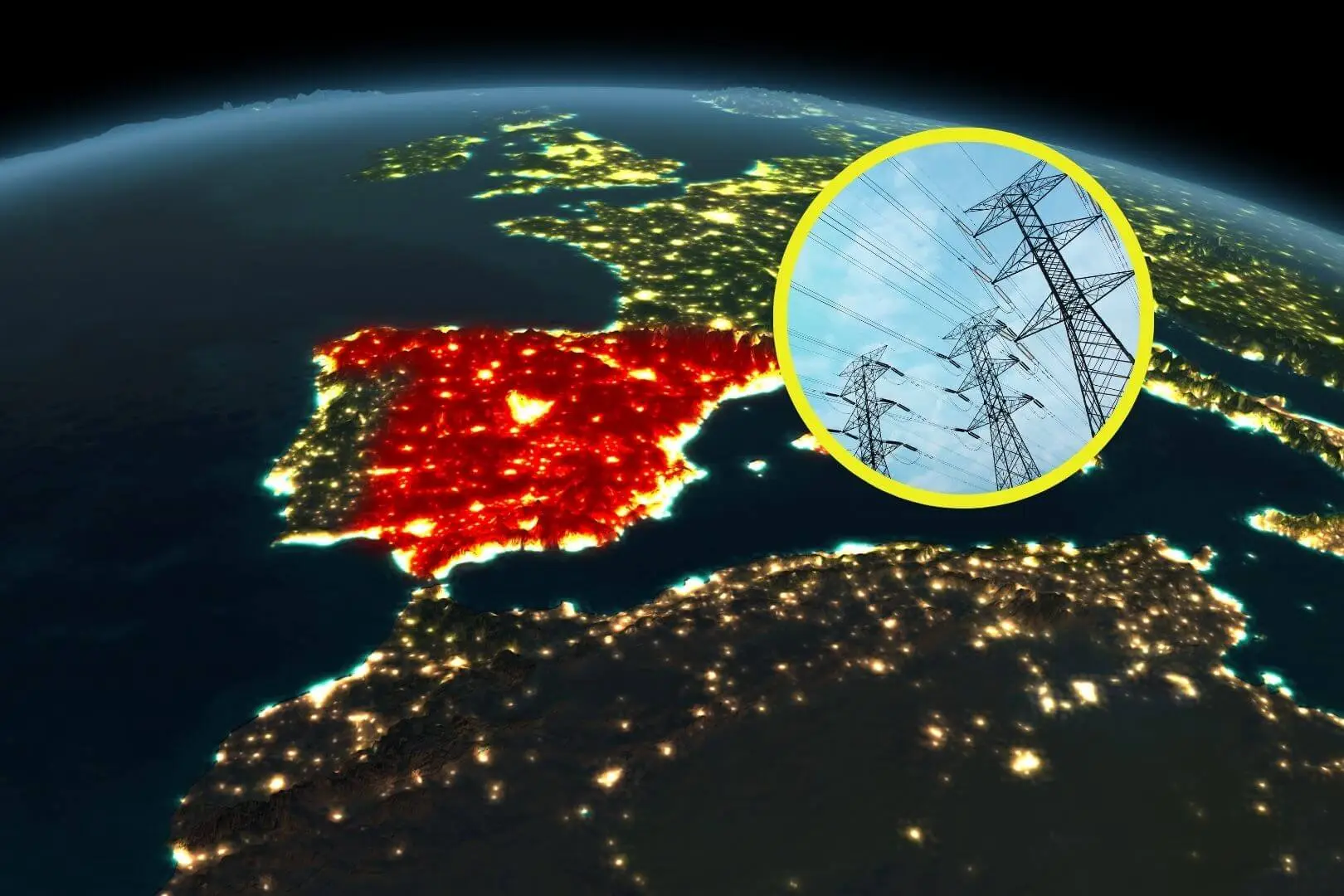
The Great Blackout of 2025: Technical Failure or Cyberattack?
On Monday, April 28, 2025, at exactly 12:33 p.m., millions of people across Spain and Portugal were suddenly left without power. Within seconds, traffic lights, trains, elevators, hospital systems, mobile networks, and payment systems went offline. What initially appeared to be a regional outage quickly revealed itself as one of the largest power grid failures in recent European history.
Although Spain’s national grid operator, Red Eléctrica Española (REE), initially cited an “unusual disturbance” and a “zero-energy” event, several media outlets and analysts began to raise an alarming possibility: that this may have been a coordinated cyberattack targeting the European energy system.

Timeline of the Blackout
At 12:33 p.m. (CEST), the Spanish power grid experienced a sudden loss of more than 15 gigawatts of electricity production — over 60% of the Iberian Peninsula’s energy demand at the time. Just five minutes later, at 12:38, Spain’s system automatically disconnected from the European power grid in a protective response to the instability.
The consequences were immediate:
Subway trains, commuter rails, and trams halted in major cities like Madrid, Barcelona, Lisbon, and Bilbao.
Hospitals switched to emergency generators.
Mobile networks collapsed in many areas.
Card payments and internet access became intermittent or unavailable.
Although power began returning to some areas by 4:00 p.m., full restoration wasn’t achieved in certain locations until the early hours of April 29.
Technical Failure or Digital Sabotage?
REE’s initial explanation pointed to a massive loss of renewable energy generation, coinciding with high levels of solar and wind production. However, what has raised suspicions is the simultaneity and unusual behavior of automated systems, which responded as if facing an artificial — not natural — threat.
Several cybersecurity experts pointed out that the failure pattern resembled simulations of malware-based or digital sabotage attacks on critical infrastructure. A NATO source speaking to Le Monde (anonymously) stated that “the possibility of a hostile digital intervention is being seriously considered.”
Moreover, the fact that disruptions were also reported in Morocco, southern France, and minor disturbances in Denmark, Italy, the UK, and the Netherlands has led many to question whether this was merely a technical accident.
Precedents of Energy-Related Cyberattacks
The world has seen similar events before. In December 2015 and again in 2016, Ukraine’s power grid was the target of cyberattacks attributed to Russian-linked hacker groups. The malware Industroyer left hundreds of thousands without power. Experts believe similar techniques may have been used in the 2025 blackout.
“The high level of automation, remote control, and digital dependency in today’s energy systems makes them extremely vulnerable,” said Eva Salgado, an IT engineer specializing in SCADA systems. “It’s no longer about cutting wires or sabotaging towers — now it’s about infiltrating the algorithms that balance production and demand.”
Government Response: Caution and Secrecy
Spain’s Minister for the Ecological Transition, Teresa Ribera, publicly stated that “all hypotheses are on the table” and called for calm. Prime Minister Pedro Sánchez rejected the idea that renewable energy sources were to blame, although Red Eléctrica had warned as early as February 2024 about the risks of over-reliance on renewables without proper backup infrastructure.
Spain’s national cybersecurity agency (INCIBE) is now working with the National Cryptologic Center and Europol to investigate whether unauthorized access occurred in SCADA and EMS (Energy Management Systems) of affected networks. Technical cooperation has also been initiated with France, Germany, and Portugal.
Which Countries Were Affected?
While Spain and Portugal

were the most heavily affected, additional disruptions were reported in:
Southern France, with power outages
lasting up to 45 minutes in the French Basque Country.
Andorra, which also experienced outages due to grid connection.
Morocco, where telecom companies such as Orange lost connectivity due to server failures in Spain.
Minor disturbances in Denmark, Italy, the Netherlands, the UK, and Belgium.
France’s grid operator (Réseau de Transport d’Électricité) confirmed localized blackouts and fluctuations linked to instability on the Iberian Peninsula.
Debunked Theories: The “Atmospheric Phenomenon”
One of the first viral theories, reported by some Portuguese media, claimed that a rare atmospheric phenomenon in Spain triggered the blackout. It cited “extreme temperature variations” causing vibrations in high-voltage lines.
Spain’s national meteorological agency (AEMET) quickly refuted the claim, stating that no unusual weather or temperature fluctuations occurred. Similarly, Portugal’s national grid operator REN denied ever making such a statement.
Another early theory blamed a wildfire beneath transmission lines in France. While investigators haven’t ruled out an electrical disruption in that region, no direct correlation has been confirmed.
Exposed Vulnerabilities and Lessons Learned
This incident has revealed several weaknesses in Europe’s energy infrastructure:
Low interconnection between Spain and the rest of Europe: Only about 5% of Spain’s capacity is interconnected with other countries, making it an «energy island» with limited emergency support.
Lack of large-scale energy storage: Despite its leadership in solar and wind generation, Spain lacks sufficient battery storage or green hydrogen systems to provide reliable backup.
Cybersecurity gaps in the energy sector: Many critical systems run on outdated or proprietary software with poor digital protection.
International Expert Opinions
Several analysts in the U.S. and UK have expressed growing concern. Professor Greg Allen from the Harvard Center for Tech Security told The Guardian:
“If it turns out this was a cyberattack, we’re looking at the first successful multinational cyberoffensive against Western energy infrastructure. This changes the rules of hybrid warfare.”
Meanwhile, NATO has activated its joint cyber defense protocols and requested technical logs from Iberian and French operators.
Conclusion: Are We Ready for the Next Blackout?
Whether this blackout was the result of a technical flaw, a cascade of unlucky events, or an intentional act of sabotage, one thing is certain: our increasingly digital society is extremely vulnerable. Power can be restored in hours — but the economic, social, and political consequences of such an event last far longer.
The Great Blackout of 2025 has served as a wake-up call. As authorities work to clarify the origin of the incident, one lesson is clear: we need more resilient, secure, and forward-thinking energy systems for the 21st century.